


























The words you wear have meaning
Walk through any Indian streetwear collection today and you will find Devanagari script, Sanskrit phrases and Indian philosophical concepts woven into the design. This is not decoration. This is a cultural movement — and every word carries centuries of meaning.
This article decodes the Sanskrit on THE SUNYA garments and explains why these words matter — not just as design, but as philosophy you can wear.
Why Sanskrit on streetwear?
Sanskrit is the classical language of India — the language of the Vedas, the Upanishads, the Bhagavad Gita, and the mathematical treatises that gave the world zero. It is also one of the most visually striking scripts in the world. Devanagari — the script used to write Sanskrit — has a geometric beauty that translates powerfully to graphic design.
For Indian streetwear designers, Sanskrit offers something no other design source can: a direct line to 3,000+ years of philosophical depth, encoded in a visual language that is simultaneously ancient and contemporary.
The Sanskrit on every THE SUNYA piece
MOKSHA — मोक्ष — Liberation
Moksha is one of the four aims of human life in Hindu philosophy (the purusharthas). It means liberation — the release from the cycle of birth and death, the moment when the individual self recognises its identity with the universal.
On the MOKSHA hoodie, the मोक्ष emblem appears as matte tonal embroidery on the chest — quiet from a distance, intricate up close. The design reads the way the concept itself works: it reveals layers when you sit with it.
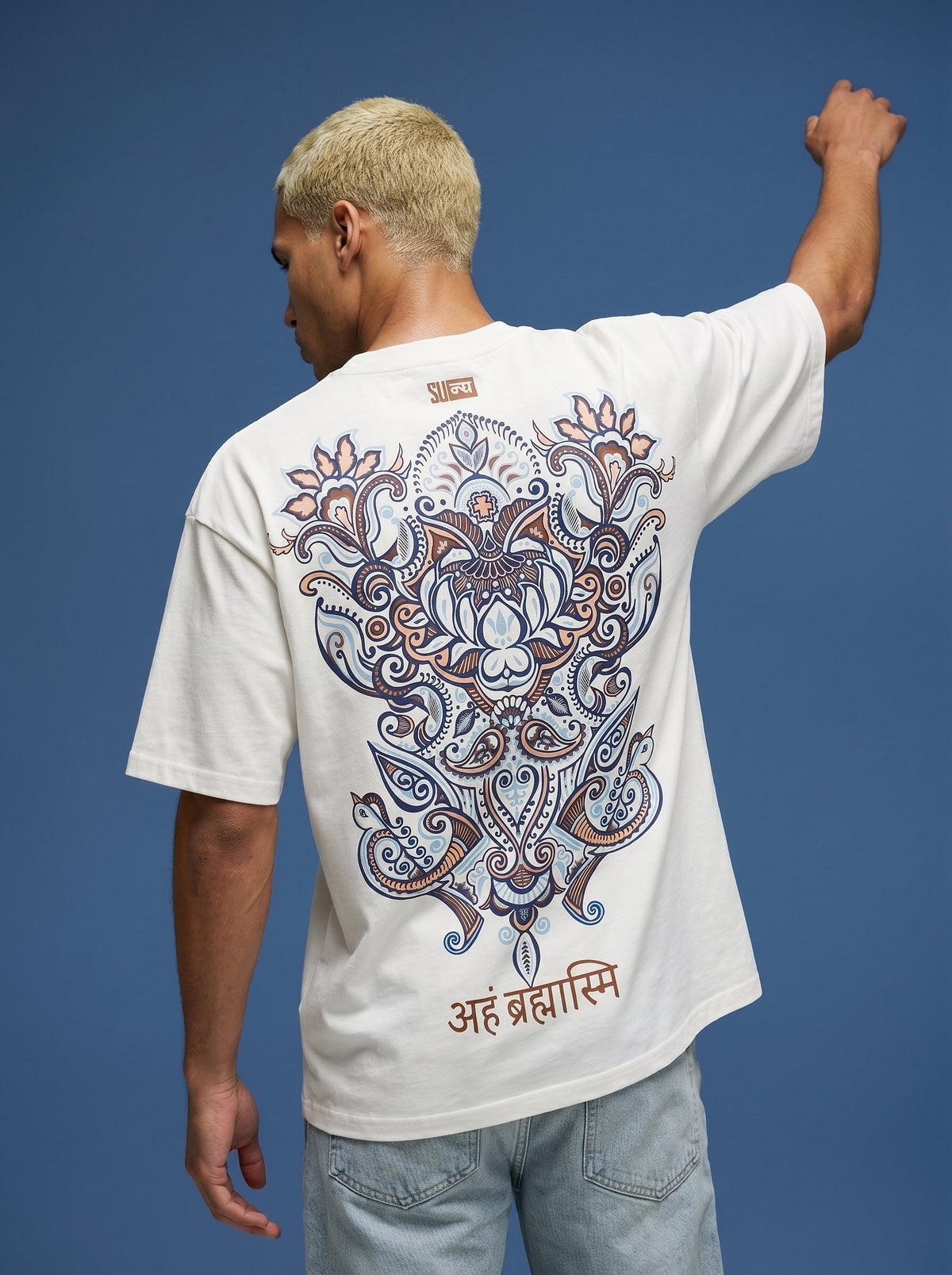
AHAM BRAHMASMI — अहं ब्रह्मास्मि — "I am the universe"
This is one of the four mahāvākyas — the great statements of Vedantic philosophy, found in the Bṛhadāraṇyaka Upanishad. It asserts the identity of the individual self (ātman) with the universal reality (Brahman).
On the AHAM BRAHMASMI tee, the full phrase appears in clean modern typography across the front. It is intended as a quiet reminder, not a slogan — the kind of statement that needs no volume.
TRINETRA — त्रिनेत्र — The third eye
Trinetra literally means "three eyes" in Sanskrit. It refers to the third eye of Shiva — the eye of inner perception, insight and awareness beyond ordinary sight. In yogic philosophy, the third eye (ājñā chakra) is the seat of intuition.
On the TRINETRA tee, a centred chest motif in tonal screen print captures the concept — a symbol that asks for attention, not a logo that demands it.
MAUN — मौन — Silence
Maun is the Sanskrit and Hindi word for silence — but not the absence of sound. In Indian spiritual practice, maun vrat (the vow of silence) is a deliberate practice of inner stillness. It is silence as power, not silence as lack.
The MAUN sweatshirt carries a single embroidered emblem — intentionally restrained, letting the cut and fabric speak instead.
ĀRAMBH — आरम्भ — Beginning
Ārambh means beginning, commencement, the first step. It carries the energy of initiation — the moment before momentum builds.
The ĀRAMBH hoodie is the flagship piece: 350 GSM, red on black, with Sanskrit text स्वर ज्ञानम् (svar jñānam — "knowledge of sound/self") and detailed hood lining with traditional border accents.
SUNYA — शून्य — Zero
Sunya is the Sanskrit word for zero — and the name of our brand. But शून्य does not mean "nothing". It means the void from which all creation emerges. India invented zero as a mathematical concept (Brahmagupta, 628 CE), and the philosophical zero — śūnyatā — is central to Buddhist and Vedantic thought.
The SUNYA tee carries the Devanagari script शून्य across the front. Not a logo. A philosophy. Read the full meaning of Shunya →
The deeper pattern
Every Sanskrit term on a THE SUNYA garment follows a principle: the word is never decorative. It is a concept — a piece of philosophy compressed into script, placed on fabric, worn on the body. The garment becomes a carrier of meaning.
This approach draws from an Indian design tradition that is thousands of years old. Temples carry Sanskrit inscriptions. Textiles carry auspicious symbols. Jewellery encodes mantras. THE SUNYA applies the same logic to streetwear: every surface is an opportunity for meaning.
How to learn more
- What does Shunya mean? The full philosophy →
- Premium streetwear in India: the 2026 guide →
- Browse Sanskrit-inspired t-shirts →
- Browse hoodies with Sanskrit motifs →
Wear the words
Sanskrit on streetwear is not a trend. It is a return to source — a generation of Indian designers and consumers choosing to wear their heritage with intention and pride. Every word you see on a THE SUNYA garment was chosen for its weight, its history, and its resonance with the present.
Shop best sellers → | Free shipping across India. 7-day exchanges.




Share:
The premium hoodie buying guide for India 2026
The oversized fit guide — how to size without losing structure