








































What does Shunya mean? The philosophy behind THE SUNYA
Shunya: the meaning behind THE SUNYA
What is Shunya?
Shunya — शून्य — is the Sanskrit word for zero. But in the original language, it carries far more weight than a numeral. शून्य (śūnya) means void, emptiness, the open space from which all things emerge. It is the point before creation. The breath before the word. The silence that holds the sound.
The word appears across three transliterations in everyday use: Sunya, Shunya, and Śūnya. In our brand identity, it appears as SUन्य — a visual union of the Latin and Devanagari scripts that mirrors the design philosophy of the brand itself.
Shunya is not nothing. Shunya is everything before it becomes something.
The mathematical Shunya — India's gift to the world
India invented zero. This is not folklore — it is documented mathematics.
In 628 CE, the Indian mathematician Brahmagupta wrote the Brāhmasphuṭasiddhānta, the first text to formalise zero as a number with defined arithmetic rules. Before Brahmagupta, zero existed as a placeholder in Babylonian and Mayan systems, but it was Indian mathematicians who gave it operational meaning — the ability to be added, subtracted, multiplied.
The concept travelled from India to the Arab world via the scholar al-Khwārizmī (from whom we get the word algorithm), and from there into European mathematics. The numeral system we use globally today — 0, 1, 2, 3, 4, 5, 6, 7, 8, 9 — is called the Hindu-Arabic numeral system for this reason.
Without Shunya, there is no binary code, no digital computation, no modern mathematics. The void is the foundation.
The philosophical Shunya — emptiness as fullness
In Indian philosophy, Shunya carries a meaning that runs far deeper than mathematics.
In Buddhist thought, śūnyatā (शून्यता) — often translated as "emptiness" — is a central teaching of the Mādhyamaka school, articulated most famously by Nāgārjuna in the 2nd century CE. Śūnyatā does not mean nothingness. It means that all phenomena are empty of inherent, independent existence — they arise in dependence on conditions, causes and perceptions. Understanding this is considered a path to liberation.
In Vedantic philosophy, the concept appears differently but with equal weight. The Upanishads describe Brahman — the ultimate reality — as nirguṇa (without qualities), a formless ground of being from which all form arises. This is not absence. It is potential. It is the canvas before the painting, the page before the word.
In Yoga and meditation, practitioners seek to reach a state of śūnya — the point of stillness between thoughts, the silence between breaths. It is considered the space where awareness exists without the noise of identity.
Across all these traditions, the pattern is the same: zero is not empty. Zero is the starting point of everything.
Why we named our brand Shunya
THE SUNYA was founded by Paras Soni with a single conviction: that Indian streetwear could carry the depth of Indian philosophy without losing the clarity of modern design.
The name was deliberate. From Zero to Infinite — our founding principle — is not a motivational tagline. It is a direct translation of the logic of Shunya: that the void is where creation begins, that restraint is a form of power, and that a garment can carry meaning without wearing it on the surface.
Every collection begins from a zero point — a blank page, a clear intention. The Sanskrit motifs, the Devanagari script, the sacred geometry that appears across our hoodies, tees and shirts all originate from this starting principle. We don't decorate garments with Indian symbols. We let the symbols inform the garment.
The result is streetwear that reads as minimal from a distance and reveals its depth up close — the same way Shunya itself works.
Sanskrit on every garment
Every THE SUNYA piece carries a thread of Sanskrit philosophy. Here are a few:
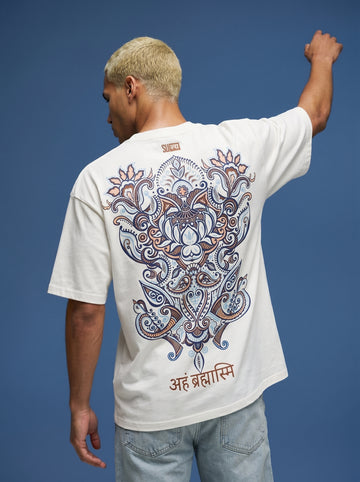
- AHAM BRAHMASMI — अहं ब्रह्मास्मि — "I am the universe." One of the four great Vedantic statements (mahāvākyas). Rendered in clean modern typography across the front.
- MOKSHA — मोक्ष — Liberation. The release from cycles. A matte tonal embroidery that reads quiet from a distance and intricate up close.
- TRINETRA — त्रिनेत्र — The third eye. The inner sight. A centred chest motif in tonal screen print.
- MAUN — मौन — Silence as practice, not absence. A single embroidered emblem, letting the cut and fabric speak.
- ĀRAMBH — आरम्भ — Beginning. The first step. Red on black abstract floral with Sanskrit text स्वर ज्ञानम्.
Each piece is designed to be wearable philosophy — expressive where it matters, minimal where it counts.
Three ways to write the same word
You will see our name written in three forms. All three are correct:
- Sunya — the simplified English transliteration, used in domains and URLs
- Shunya — the phonetically accurate transliteration, closer to the Sanskrit pronunciation (the "sh" sound is a retroflex sibilant, श)
- SUन्य — our brand mark, a visual hybrid of Latin and Devanagari scripts that represents the fusion at the heart of the brand
Whether you found us searching for "sunya meaning", "shunya brand" or "SUन्य streetwear" — you've arrived at the same place. The starting point.
Shop the brand born from Shunya
Every THE SUNYA piece is built from this philosophy — premium Supima cotton, Indian heritage motifs, German-threaded construction, and a design language that begins from zero.
Explore our t-shirts, hoodies, shirts and sweatshirts. Free shipping across India. 30-day free returns. Money Back Promise.


