

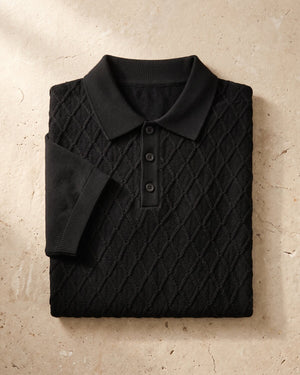
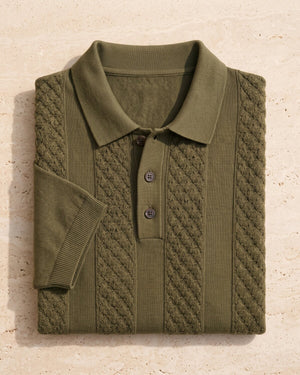
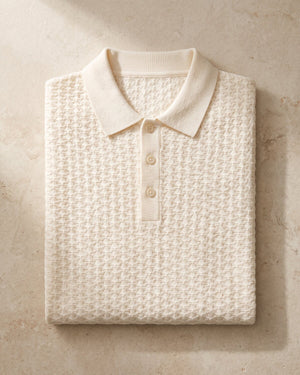
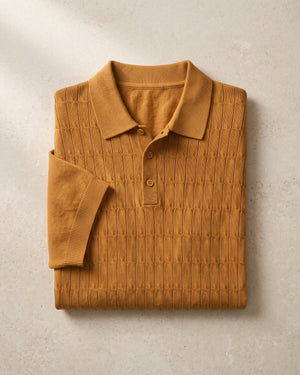
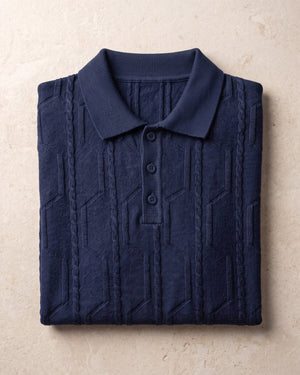
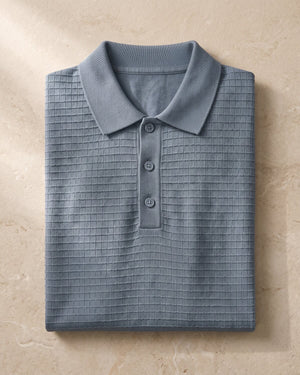
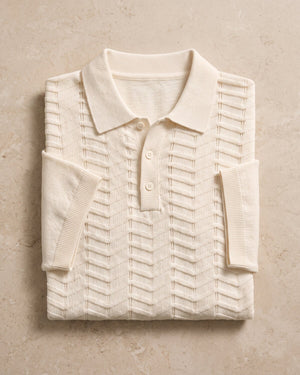
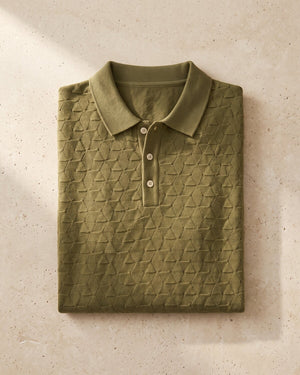








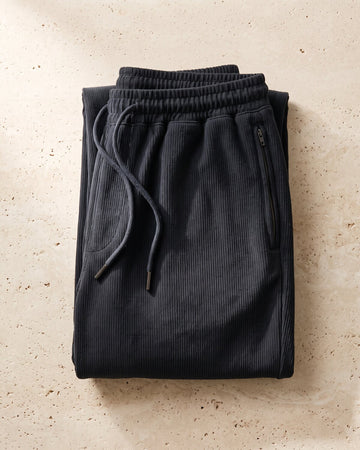
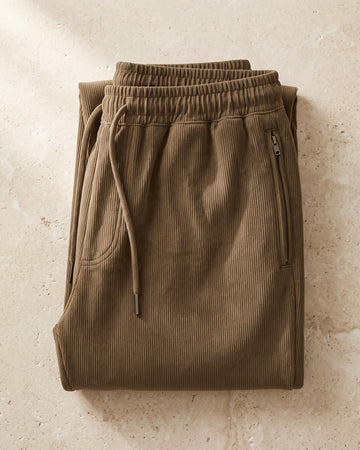
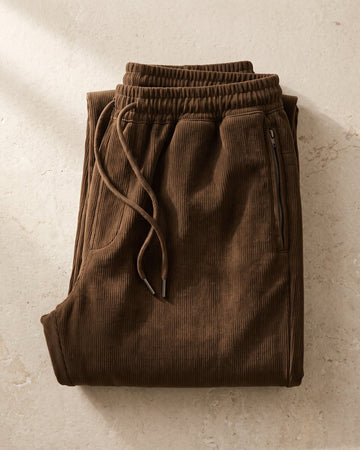
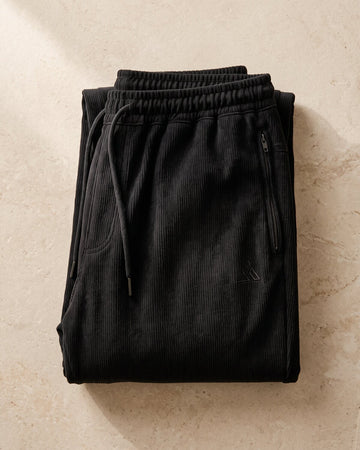

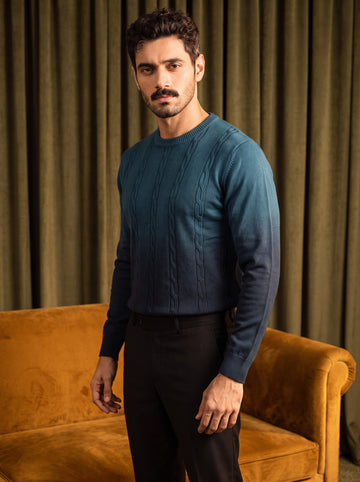
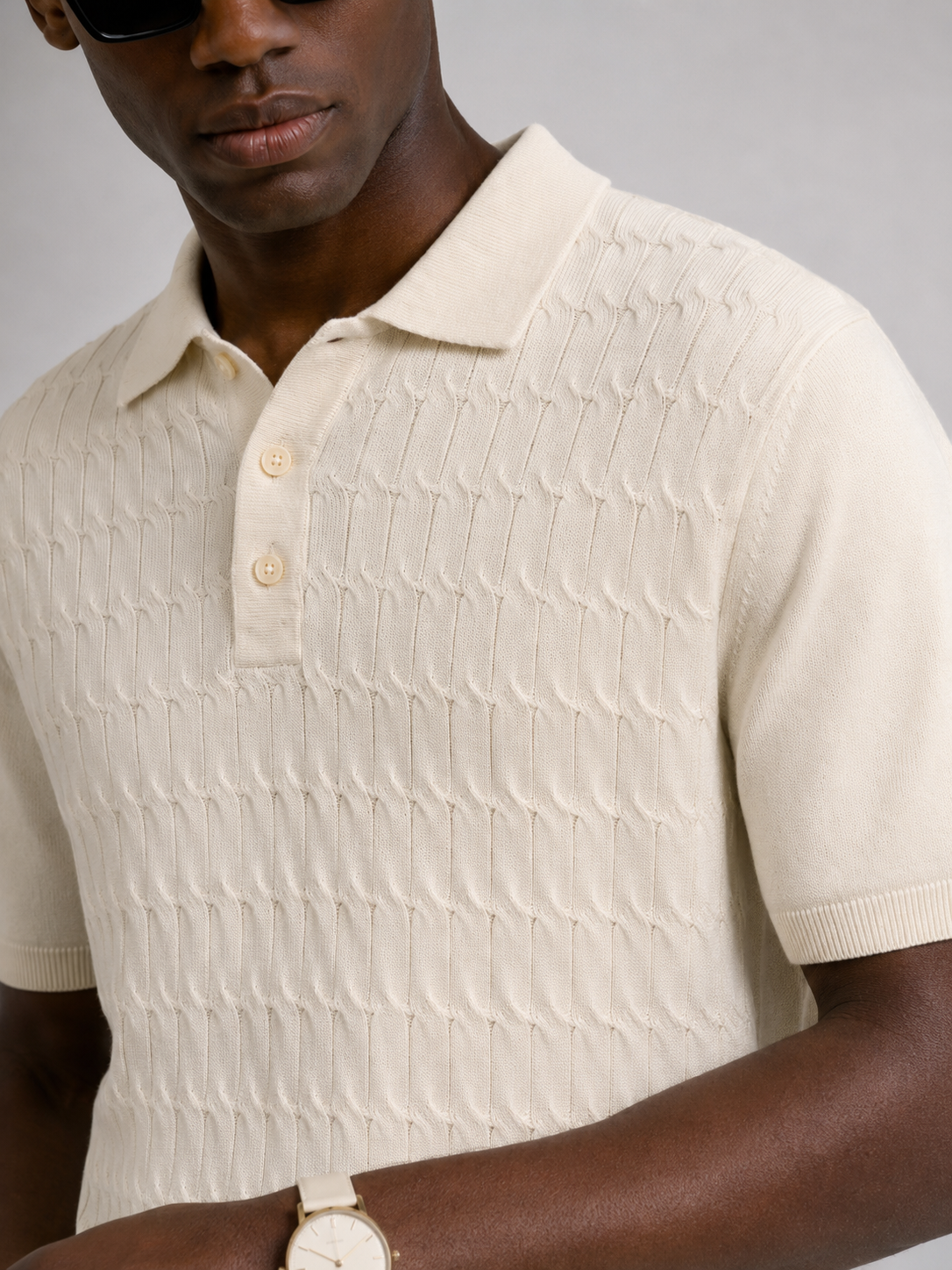
Forty-eight of the forty-nine polos in this catalogue are knits: eight surface structures, each made in the same six colours. There is no printed motif anywhere in the range. Every pattern in it is made of stitch.
That raises questions a size chart cannot answer. Which texture is loud and which is quiet? Does camel show more than black? If the collar is knitted rather than cut from cloth, how do you wash the thing without ruining it?
Knit, piqué and jersey are not the same polo
Piqué is the default polo fabric — a double knit with a small raised waffle, made by the metre and then cut and sewn to shape. Jersey is the flatter, thinner alternative: the fabric of the t-shirt, and of most promotional polos. Both are knits in the technical sense, and both are treated as cloth.
A knit polo in the sense used here behaves more like a fine sweater with a polo collar. The surface pattern is stitch structure rather than a finish applied to plain fabric, so it cannot fade, crack or wash out the way a print can. The collar has body of its own, and the ribbed cuffs and hem grip instead of hanging.
The trade-off is honest. A structural knit is warmer than jersey at the same weight, because raised stitch traps air, and it takes longer to dry. In exchange it holds a shape.
What fine-gauge means
Gauge is the number of needles per inch on the machine that knits the fabric. More needles means smaller stitches, a denser surface and a thinner, smoother cloth. Fine-gauge is the end of that scale where a knit stops looking like a jumper and starts looking like a shirt.
Two things follow. First, a fine-gauge structure can carry detail: a square lattice at graph-paper scale is only legible because the stitches are small enough to draw it, where a chunky gauge would collapse the same pattern into a blur. Second, fine-gauge cotton is wearable in Indian weather in a way a heavier knit is not — closer to a shirt in weight than to a sweatshirt.
All eight structures are knitted in fine-gauge cotton and share the same details: a classic polo collar, a three-button placket, plain-knit sleeves, and ribbed cuffs and hem. Everything that distinguishes them happens on the surface of the body.
The eight structures compared
Read the table by the last column. Visual weight is how much the texture announces itself from across a room. All eight are tonal — pattern made only of light and shadow — so none of them shouts, but there is a real distance between GRID and TILE.
| Structure | Surface | Direction | Visual weight |
|---|---|---|---|
| GRID | Fine square lattice at graph-paper scale; the most precise in the set | All-over | Lowest |
| CANE | Vertical ribs knotted at intervals, like a stalk; slim and upright | Vertical | Low |
| VANE | Arrowhead columns divided by fine cable ribs; a chevron rhythm read up close | Vertical | Low to medium |
| FERN | Fine herringbone rows stacked so each folds into the next; dense and tonal | Horizontal rows | Medium |
| HIVE | Tight, small-scale relief interlocking across the body; felt before it is seen | All-over | Medium |
| CORD | Seed-textured panels alternating with flat knit; a corduroy rhythm in yarn | Vertical | Medium |
| LEAF | Wider-gauge relief with a rounded, gentler line; pattern at distance, texture up close | All-over | Medium to high |
| TILE | Raised blocks in offset rows; the boldest texture, catching light along every edge | Horizontal rows, offset | Highest |
Two notes the table cannot carry. HIVE and LEAF are both all-over relief at different scales, and scale is the thing to judge — look at the close-crop photograph on each product page rather than the word. And CANE, CORD and VANE run down the body while FERN and TILE run across it, which is the biggest single difference in how a polo reads on a tall frame versus a broad one.
Choosing between the six colours
The six are Black, Camel, Cream, Navy, Olive and Slate. Nothing bright, which makes the decision less about colour than about how much of the texture you want visible.
- Camel shows the most. A warm mid-tone is the most generous light there is for raised stitch.
- Cream is the softest read. Light does the work, and the texture only surfaces when someone is near.
- Black turns the pattern into pure shadow — present, never announced.
- Navy is deep and even, the most formal of the six without tipping into office wear.
- Olive is muted and earthy, and sits easily against denim, khaki and bone.
- Slate is a dusty grey-blue with a soft matte finish.
The rule worth following: pair a bold structure with a quiet colour, or a quiet structure with a colour that shows. TILE in camel is the loudest combination in the range and looks it. The GRID knit polo in navy is the opposite pole — the most restrained pattern in the most formal shade, and the one to buy if you want a polo that passes for plain until someone is a metre away.
Sizing, and why it carries across the range
All eight structures are built on the same regular block. The size you take in CORD is the size you take in TILE; nothing about the surface changes the pattern underneath it. Sizes run M, L and XL, and the price is ₹1,549 across all forty-eight.
If you are between sizes, the decision is about use rather than measurement — take the smaller size for a polo you will wear on its own, the larger if you plan to layer it under a jacket or overshirt. The ribbed hem holds either way.
One polo in the category sizes differently. Velmoré is a short-sleeve quarter-zip in 220 GSM Cotrise rather than a fine-gauge knit, and it runs XS to XXL.
Washing and storing a cotton knit
The collar fails first, and almost always for one of two reasons: it was hung on a hanger, or it was wrung out while wet. Both stretch the neckline at the moment the fibre is least able to recover.
- Wash cold, inside out, on a gentle cycle. Heat is what shrinks cotton and what relaxes a rib.
- Do not wring. Press the water out between your palms, or roll the polo in a towel and press.
- Dry flat, out of direct sun, with the collar laid in its natural position rather than folded back.
- Fold; never hang. A hanger loads the entire weight of the garment onto the shoulders and the neckline.
- Button the placket before folding, so the front edges stay aligned in the stack.
- Steam rather than iron. If you must iron, use low heat, inside out, and lift rather than drag across the texture.
On pilling: any cotton knit will pill slightly where it rubs — under the arms, along a seatbelt line, where a bag strap sits. That is abrasion rather than a fault, and a fabric comb removes it in about a minute.
When a knit polo works and a t-shirt or a shirt does not
The gap it fills is narrow but real: occasions with a collar requirement and no formality requirement. A t-shirt has no collar. A shirt brings a cuff, a full placket and an implied tie. The knit polo gives you the neckline without the rest of it.
- Dinner where a shirt overdresses you. A CANE knit polo in cream with dark trousers is finished without looking like you tried.
- Under an unstructured jacket. Texture is what stops the visible panel from reading as an undershirt.
- Travel. Knit structure hides the creases a woven shirt records permanently. A FERN knit polo in camel comes out of a bag wearable.
- Warm-weather offices with no dress code. Navy or slate, worn untucked, sits above a t-shirt and below a shirt.
Where it is the wrong answer: anything requiring a tie, and anything genuinely athletic. A structural knit is not a performance fabric and is not trying to be. Browse the full knit polo collection to compare the eight structures side by side.
Frequently asked questions
What is the difference between a knit polo and a piqué polo?
A piqué polo is cut and sewn from waffle-textured fabric made by the metre, while a knit polo of this kind is a fine-gauge knitted garment whose pattern is built out of stitch structure. The practical difference is body: the knit holds its collar and hem shape, and the surface pattern cannot wash out.
Do the knit polos shrink in the wash?
Cotton shrinks when it meets heat, so wash cold and dry flat and the fit will stay where it started. The failure mode to avoid is a hot wash followed by a tumble dryer, which tightens the body and relaxes the ribbing at once.
Which structure is the most versatile?
GRID is the most versatile, because it is the most restrained pattern in the range and therefore the easiest to place. It reads as a plain polo at conversational distance and only resolves into a fine square lattice up close. TILE sits at the other end, for when you want the texture noticed.
Does my size carry across all eight structures?
Yes. All eight are built on one regular block, so a medium in HIVE fits like a medium in VANE, and the surface structure does not change the measurements. The knit polos are made in M, L and XL.
What do they cost, and what is the shipping?
Every knit polo is ₹1,549, and shipping is free anywhere in India. Returns are free within 30 days of delivery. All forty-eight — eight structures across six colours — are listed together in the polo collection.


Share:
The Zodiac Collection: Twelve Woven Shirts, One Per Sign
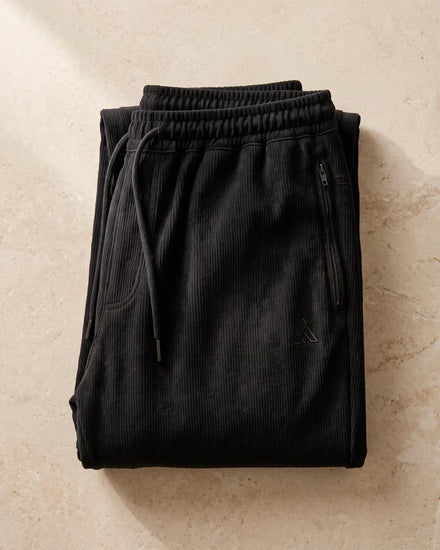
Fine-wale corduroy joggers — how to wear them, wash them, and choose a colour